Gifts for Coworkers: 25 Smart Ideas That Actually Stick
Summary
Gifts for coworkers work best when they are either genuinely useful or genuinely personal. The closer the relationship, the more specific you can go. Most gift exchanges cap at $25, which rewards local and consumable choices over generic options. Personalized items with a name or engraving outlast generic equivalents on desks by months. Skip alcohol unless you are certain, and avoid gifts that require action from the recipient.

Gifts for coworkers follow one rule: if it can sit on someone's desk six months from now and they would still notice it, it is a good gift. If it ends up in a donation box by February, it was not. That is the desk test. The best options are either genuinely useful (a charger, a quality notebook) or genuinely personal (their name engraved on something, their particular obsession remembered). Everything in between is mostly ambient noise.
Why most coworker gifts fail the desk test
The 56% figure keeps appearing in workplace gift research: more than half of employees report receiving generic and impersonal gifts from employers or colleagues. The number is not surprising once you think about how most coworker gifts get chosen -- a supermarket chocolate box at 5:30pm on December 23rd, or a quick browse through a "gifts under $30" page with no filter for the actual person.
Generic gifts fail not because they are cheap but because they are nameless. A candle with no particular scent, a gift card to a store the person never visits, a branded mug from a vendor that is already stacked three deep in the kitchen cabinet. The gift works as a gesture but not as an object. It says "I acknowledged the occasion" rather than "I thought about you."
The fix is not necessarily spending more. It is narrowing. One well-chosen item that reflects what you actually know about the person lands better than a curated basket of six good-but-interchangeable things.
Three types of coworkers, three different strategies
Not all coworker relationships call for the same approach. Here is a shortcut.
The close work friend. You have had lunch with this person. You know their coffee order, their current obsession, whether they are a notebook hoarder or a minimalist. Spend $30-60, go specific, personalize if the budget holds. This is the category where Etsy and artisan shops beat a generic marketplace. A hand-thrown ceramic mug in a color they mentioned once, a book by the author they have been meaning to read, a small-batch coffee from a roaster in their city -- all of these will outlast any set of bath products.
The solid acquaintance. You share a Slack workspace and you like them, but you could not name their partner or their current podcast. Aim for $15-30, stay in the edible or consumable zone (quality snacks, a good loose-leaf tea selection, a well-designed candle with a concrete scent) or go for desk-functional. The goal is "appreciated" not "remembered forever." Something they will use up and refill or replace with their own money is a success.
The whole team. Secret Santa caps, gift exchanges, or a collective farewell gift. Budget usually runs $10-25 per person. Here, funny wins -- but only if it is not at anyone's expense. The reversible octopus plushie that flips between happy and anxious, the Genuine Fred Desk Dumpster pencil holder, a good Uno tin. These move around the table and nobody ends up offended or left out.
When a name on a gift changes everything
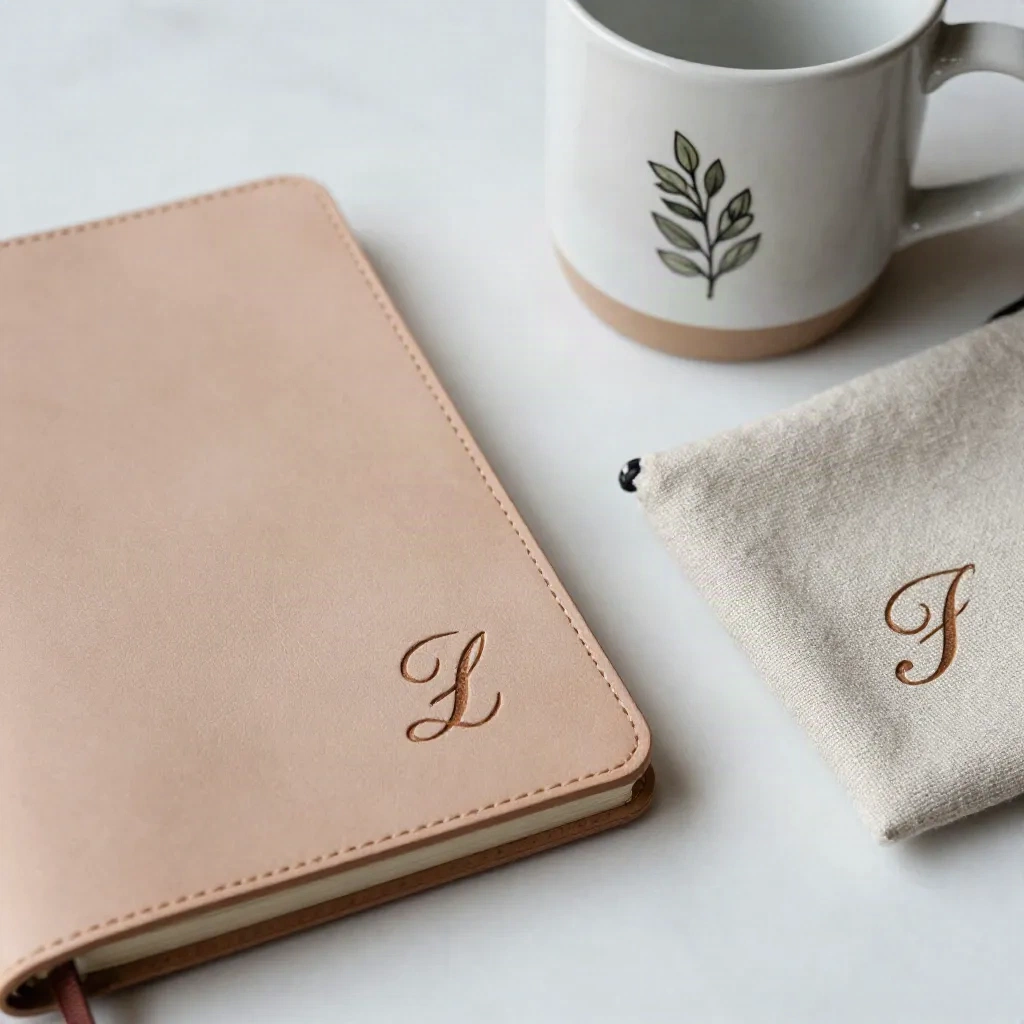
There is a reason engraved items hold their place on desks for years while generic versions get rotated out. The mechanism is simple: an object with someone's name on it becomes theirs in a way a generic version cannot. It has staying power.
This does not require a leather monogram workshop or a budget above $50. A mug with a person's initial and their city. A notebook with their name debossed on the cover. A set of notecards printed with their name in a typeface they would actually choose. A small enamel pin that spells out a nickname only three people use. These are all available under $40 on handmade marketplaces or personalized stationery shops.
One note on execution: the name should be the whole point, not a footnote. "A beige tote bag with your name somewhere on the inside label" is not a personalized gift. "A notebook where your name is the design, in the font you picked, in the color you chose" is. The difference is whether the personalization required a decision or just a database field.
Practical gifts that survive the reshuffle
Office desks get reshuffled. People change jobs, switch teams, go fully remote. The gifts that survive this cycle are the ones that work outside the office too. Here is what actually qualifies.
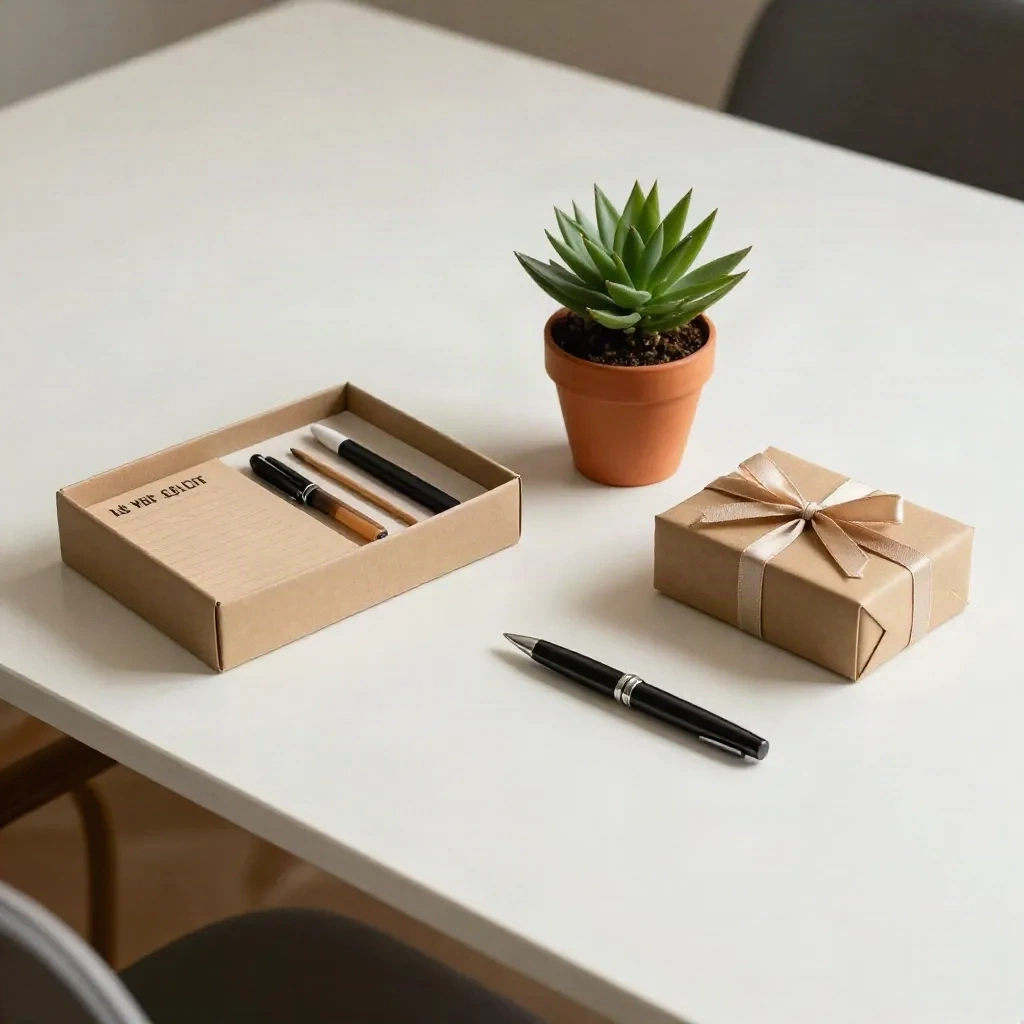
A proper charging cable. One that does not fray at the neck within three months. Anker's range sits in the $15-25 zone and gets used daily. Not glamorous, but it will be there in a year.
A quality pen. Not a hotel pen, not a branded giveaway. The Uni-ball Jetstream is under $10 and lives in every designer's bag. The Lamy Safari is $30 and stays on desks. A pen that writes smoothly is noticed every single day.
A desk plant. Small, in a terracotta pot, needs almost nothing. A succulent or a ZZ plant works for offices with irregular watering. Moves easily when they change seats. Looks intentional even if it is not.
A lay-flat notebook. Not a cheap branded notepad with the previous employer's logo. Something they would buy for themselves: thick pages, a cover that holds its shape, a binding that stays open on a desk. Moleskine works; there are better options at similar prices.
The test for practical gifts: would they buy it with their own money? If yes, you have done well. If "maybe, if it was on sale at the airport," you are in generic territory and should reconsider.
What the $25 cap actually buys you
Most Secret Santa and White Elephant exchanges cap at $10-25. That is not a constraint, it is a constraint that forces better choices.
At $15-25, you can get: a quality tea selection in a reusable tin, a well-designed candle from a small brand, a set of fancy stationery, or a local specialty food item from a market or artisan shop. The $25 cap rewards local knowledge. A bag of beans from a good local roaster, a small-batch hot sauce, a jar of honey from a regional producer -- these land better than something pulled from a brand shelf because they carry a story. "I got this at [name of place]" is something the person will repeat. That is value the packaging cannot provide.
At $10-12, you are in consumable territory: a nice single-serve coffee kit, a flavor pack of good loose-leaf tea, a small bar of high-quality chocolate. Not memorable as an object, but appreciated in the moment. Sometimes that is the right level of investment for the occasion.
What does not work at the $25 cap: anything that requires assembly, anything with a logo prominently placed, anything scented without knowing the person's preferences. Scent is personal. A lavender candle is pleasant to 70% of people and headache-inducing to the other 30%.
Group gifts: when to pool, when to stop
Pooling for a group gift works when the person is leaving and a higher-value item from the whole team is proportionate. It also works when there is something specific they have mentioned wanting that is out of individual-gift range, and when everyone genuinely wants to contribute rather than being nudged by the most organized person in the office.
Pooling breaks down when three people carry the collection while seven people say they will Venmo you later and then don't. It also breaks down for recurring occasions -- you cannot pool for every birthday indefinitely without someone eventually opting out.
For departures, a signed card with specific notes from each team member carries as much weight as a curated selection three people spent a week arguing about. The signatures matter. "Working with you on X project taught me Y" in handwriting will be read more times than a gift card balance.
What usually goes wrong (short list)
Alcohol, unless you are certain. A bottle of wine seems universal until it is not. Some people do not drink. Some have specific preferences. Some are in recovery and will not say so in a work context. A nice tea or specialty food item carries none of this risk.
Oversized gifts for casual exchanges. A large item signals an imbalance in a context where nobody asked for depth. A $150 item in a $25 exchange is not generous, it is uncomfortable.
Gag gifts that punch in a direction. Office-appropriate humor exists: the desk dumpster, the chaos cube. But a gag gift that plays on someone's age, body, job title, or frustrations is not a "just a joke" moment -- it is a memory that sits there and changes the dynamic afterward.
Gifts that require action from the recipient. Subscription boxes that start next month, experiences that need booking, classes that require scheduling. Great in theory; friction in practice. People are busy and good intentions lapse. If the gift requires them to manage it to use it, the probability of it actually happening is lower than you think.
How to match the gift to the moment
There is no single right gift, but there are wrong contexts. A personalized leather notebook is appropriate for someone you know -- sending one to a colleague you have exchanged eight Slack messages with reads as presumptuous rather than thoughtful.
Match the intimacy level. The closer the relationship, the more specific you can go. The more distant, the more universally useful your selection should be. A practical, consumable item is almost never the wrong choice for an acquaintance. A specifically chosen, named, or referenced item is the right move for a close colleague.
One question that cuts through most decisions: what would feel right to receive from this person, at this budget, in this context? If you would feel awkward explaining how you chose it, choose something else. The desk test applies in both directions.