Wizard Names: Phonetics, Roots, and What Makes Them Work
Summary
Wizard names work when they follow specific phonetic and etymological rules, not when they sound vaguely exotic. The names that last across decades, from Gandalf to Merlin to Dumbledore, draw from Old Norse, Welsh, and Old English, use liquid consonants and sibilants, and stay under four syllables. This guide unpacks those patterns so you can judge any name on structure, not just instinct.
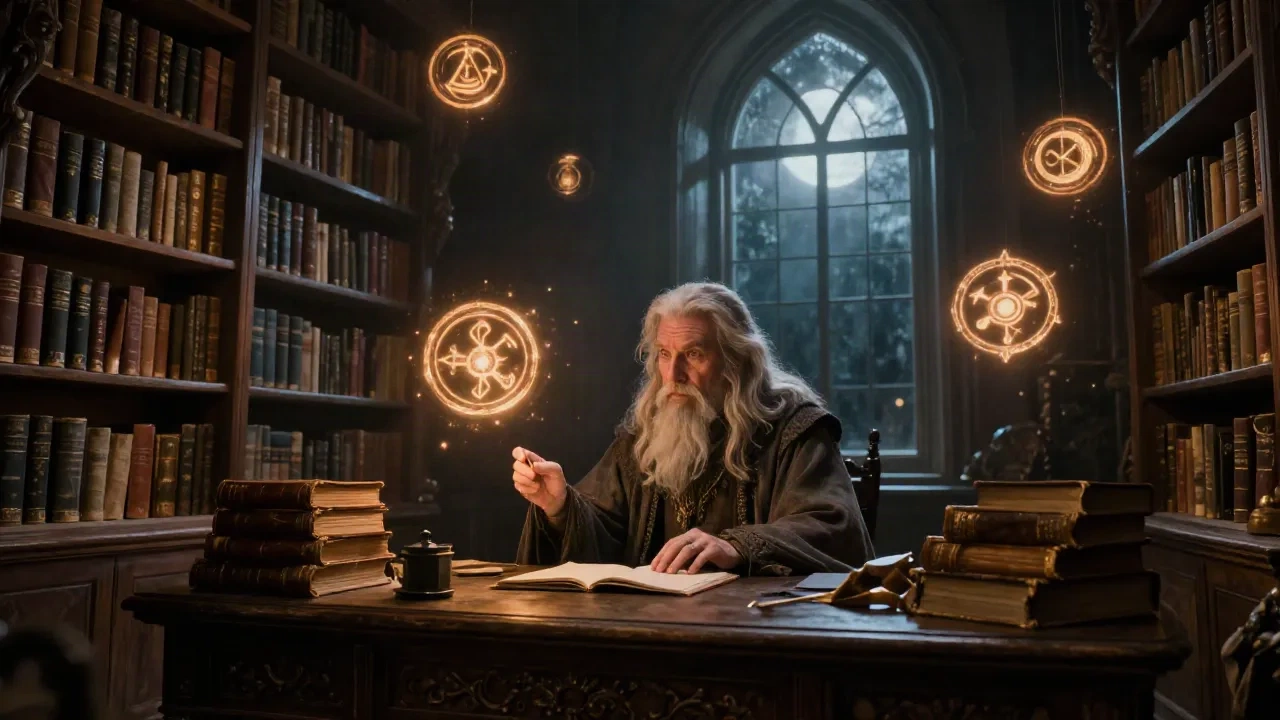
Wizard names don't fail because they sound too ordinary. They fail because the person who invented them chose sounds at random and hoped the combination would feel arcane enough. The best wizard names, the ones that survive decades of rereading and screen adaptations, follow a recognizable structure. This piece unpacks what that structure is, where it comes from, and why it matters when you're naming your own wizard character.
Why Gandalf Still Works After Seventy Years
Tolkien pulled "Gandalf" from a specific source: Völuspá, a 10th-century Old Norse poem that lists dwarf names. Gandalfr combines gandr (wand or staff) and álfr (elf). Tolkien repurposed the compound for a wizard, and the fit was accidental but structurally exact. The name sounds ancient because it is ancient, lifted from a tradition that predates modern fantasy by a thousand years.
This is the first principle behind durable wizard names: they carry an etymology, even if the reader never looks it up. Etymology gives a name what linguists call semantic depth, a resonance that readers sense without being able to identify. "Gandalf" feels like it belongs in a world older than the one you're reading about. That sensation is the payoff, not the explanation.
The name runs two syllables: GAN-dalf. A hard G opening, a consonant cluster at the close that stops the mouth. It ends before it overstays. Two syllables, held together by a strong fricative F at the end. The name has a shape.
Merlin follows the same logic. From Welsh Myrddin, probably derived from a Brittonic place name, possibly connected to the Latin Merlinus; the etymology is contested, which is itself interesting, because the name carries the weight of multiple traditions at once. Medieval writers latinized it. French poets borrowed it. Each iteration added a layer. By the time Tennyson wrote Idylls of the King, "Merlin" had been circulating for eight centuries. That kind of persistence is partly luck and partly phonetics.
The Consonants That Do Most of the Work
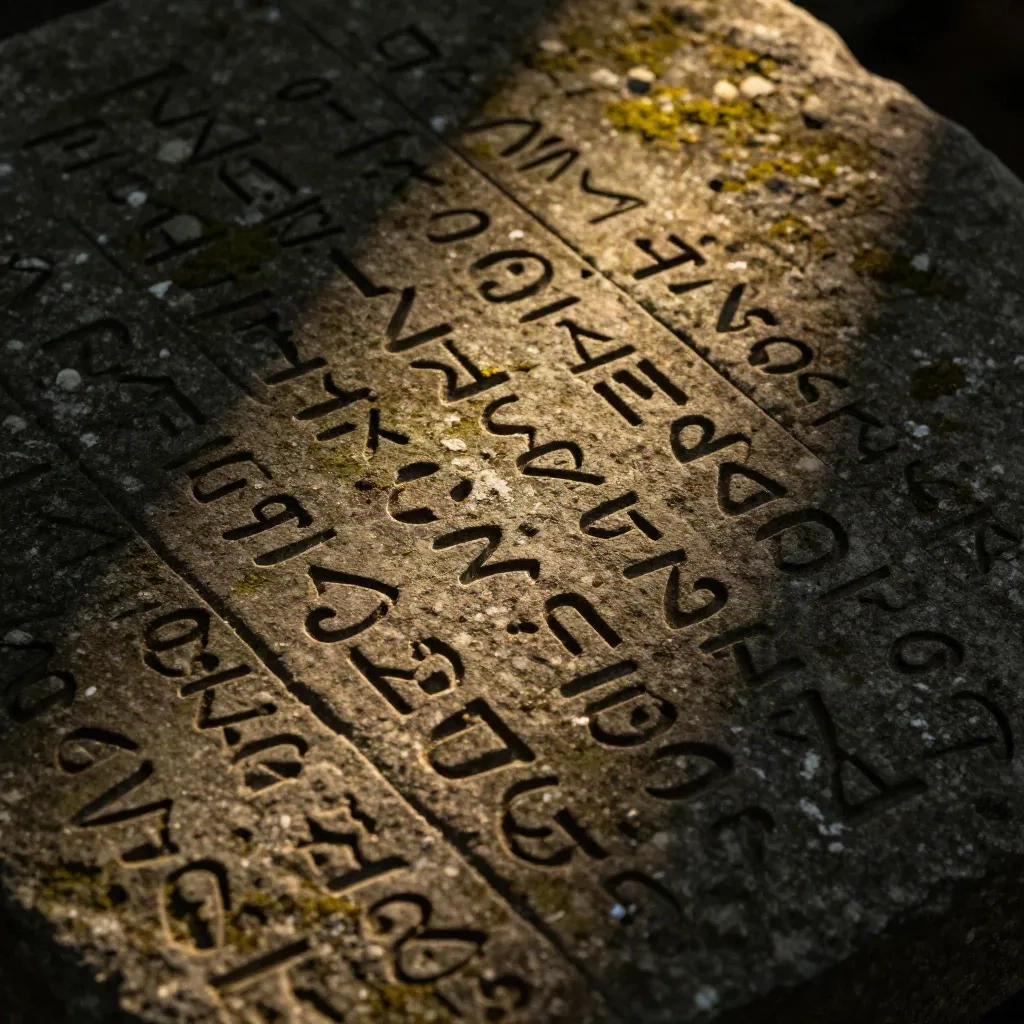
Phoneticians have identified a cluster of sounds that consistently read as archaic or arcane in English: liquid consonants (L, R), sibilants (S, Z), and fricatives (V, F, TH). Gandalf has three: L, F, and the hard G that opens it with controlled force. Merlin has two: the R and the L. Dumbledore stacks them further, running through D, M, B, R, and L in four syllables.
This is the field of phonosemantics: the study of how sounds carry meaning independent of the words they form. The association between liquid consonants and ancientness, distance, and otherness is cross-linguistically documented. Names built from L, R, S, Z, and V tend to land differently than names dominated by hard stops like P, T, and K. "Brak" reads as a warrior's name. "Bravar" reads as a scholar's. One consonant shifted.
Sibilants add a different quality: the undercurrent of incantation. Saruman, Séraphas, Zosimos: all three sound like something murmured over a flame. The Z carries particular archaic visual weight in English because it appears so rarely in everyday prose. A name containing Z immediately signals departure from the mundane register.
The practical rule: if your wizard name contains at least two liquids or sibilants and stays under four syllables, it will land in the right register for most Western fantasy traditions. This is not a formula; it is a filter. The names that pass it are not automatically strong. The names that fail it are usually struggling.
Where Iconic Wizard Names Come From
Surveying 40 canonical wizard names from English-language fantasy fiction, the etymological breakdown runs roughly as follows:
Old Norse and Old English contribute the compound-and-epithet names: Gandalf, the Witchking, Greymantle. These names feel geological, like they were worn smooth by centuries of use before landing on the page.
Latin and Greek produce the scholarly register: Albus (white), Lucius (light), Zosimos (surviving), Radagast (possibly Old Saxon, with several proposed meanings including "noble guest"). These names suggest study, accumulated knowledge, the smell of old libraries.
Celtic roots, particularly Welsh and Irish Gaelic, give us Merlin, Elspeth, Caradoc, and a dozen others. Welsh naming conventions favor consonant clusters and short vowels; the resulting names tend to feel both foreign and pronounceable, which is an unusually productive combination for fantasy.
Rowling's inventions are instructive because they look invented but aren't. Dumbledore is Old English for bumblebee; she chose it because she imagined the character humming to himself as he walked the corridors. Voldemort comes from French: vol de mort, flight from death. Grindelwald sounds German because it is, combining Grindel (a bar or grid) with Wald (forest). None of these are random. Every one reaches into existing language.
Writers who coin wizard names by assembling phonemes without linguistic grounding often produce names that look unusual but feel empty. The reader senses this, even without knowing why. Etymology is not decorative. It is structural.
The School-of-Magic Problem: Context Beats Convention
Here is what most wizard name lists miss: "wizard" is not a single archetype. A court wizard in a Florentine Renaissance setting has a different naming register than a hedge witch in Celtic mist, who differs again from a battle-mage in a Norse saga.
The name needs to fit the tradition more than it needs to sound generically arcane. "Aldric" works for a scholarly wizard in a medieval Germanic setting. It breaks for an Egyptian ceremonial mage or a Mesoamerican sorcerer. The phonetic rules described above are not universal; they describe what works in Western European naming traditions. Outside that matrix, different principles apply.
Three questions worth answering before settling on a name:
What is the cultural matrix of this wizard's tradition? A name that sounds credible in one world sounds jarringly wrong in another.
What language family would that culture's naming conventions draw from? Slavic, Arabic, Japanese, and Nahuatl naming structures produce very different phonetic profiles.
Does the name fit that matrix, or does it belong to a different world? A name can be phonetically strong and still be culturally incoherent. Both dimensions have to work.
What Most Fantasy Writers Get Wrong About Naming Wizards
The most common mistake is over-decoration: apostrophes, doubled consonants, hyphenated epithets. "Zarath'ul the Sunbreaker" is not more impressive than "Zarath." The apostrophe signals nothing. The epithet is usually a separate problem that obscures rather than enhances.
Skip the apostrophes. Fantasy fiction adopted them in the 1970s to mark alienness; readers now associate them primarily with pronunciation difficulty. A name like Zar'eth reads as an obstacle, not an invitation.
The second mistake is syllable inflation. Names with five or more syllables lose pronounceability quickly. Readers start abbreviating internally after the second or third encounter, often to something the author did not intend. If you write "Xerphalindros," your reader is calling him "Xerph" by chapter three.
The third mistake is choosing a name for its appearance on the page rather than its behavior in the ear. Fantasy fiction is subvocalized, if not read aloud at the table. A name that looks striking but is awkward to speak creates friction at every encounter. That friction accumulates.
Say the name three times in a plain sentence: "Aldric opened the door. Aldric looked at the sky. Aldric was not pleased." If the name stops feeling strange by the third iteration, it passes. If it still requires effort, it is probably one consonant cluster too dense.
Three Ways to Test a Wizard Name Before You Commit
The Telephone Test: Say the name once, verbally, to someone unfamiliar with it. Ask them to write it down ten minutes later. If they reproduce something close to the original spelling, the phoneme-to-grapheme mapping is solid. If they produce something dramatically different, the name has a decoding problem: the sounds do not match the reader's expectations about how those sounds are spelled.
The Syllable Count: One or two syllables produce high retention but lower gravitas (Merlin, Rand, Bran). Three syllables hit the sweet spot for most fantasy settings, balancing memorability with presence. Four syllables work when the character has enough page time for the reader to practice. Do not give a minor wizard a four-syllable name unless they appear in at least three chapters.
The Origin Trace: Can you gesture at where the name comes from? It does not have to be historically accurate. Invented languages count, as long as they are internally consistent. But if you cannot even loosely explain the name's origins, readers will sense the gap. "It just sounded right" is not a foundation. "It draws from Old English and Welsh naming conventions" is.
These three tests take five minutes and will eliminate roughly half the names that seem fine on first pass. The names that survive are more defensible. Defensible names last.
Using a Generator as a Starting Point, Not an Endpoint
A name generator surfaces combinations you would not have thought of yourself. That is its value. It is not a replacement for the tests above.
The most productive workflow: generate fifteen to twenty names, set aside any that fail the phonetics test on first hearing, put the survivors through the cultural matrix check, then run the telephone test on whatever remains. You usually end up with two or three candidates worth developing. That is enough.
NameGeneratorPlus's wizard name generator is built around phonotactic rules grounded in Old Norse, Latin, and Celtic naming traditions. The output already tends toward the liquid-consonant profile described above. Not every result is ready to use, but fewer of them start from zero.
The names that stay in a story are the ones that feel found rather than invented. Phonetics and etymology together produce that sensation. The generator helps you search faster. The craft is in knowing what to keep.